
The Morning After, A Family Sits Down To One Warm Meal
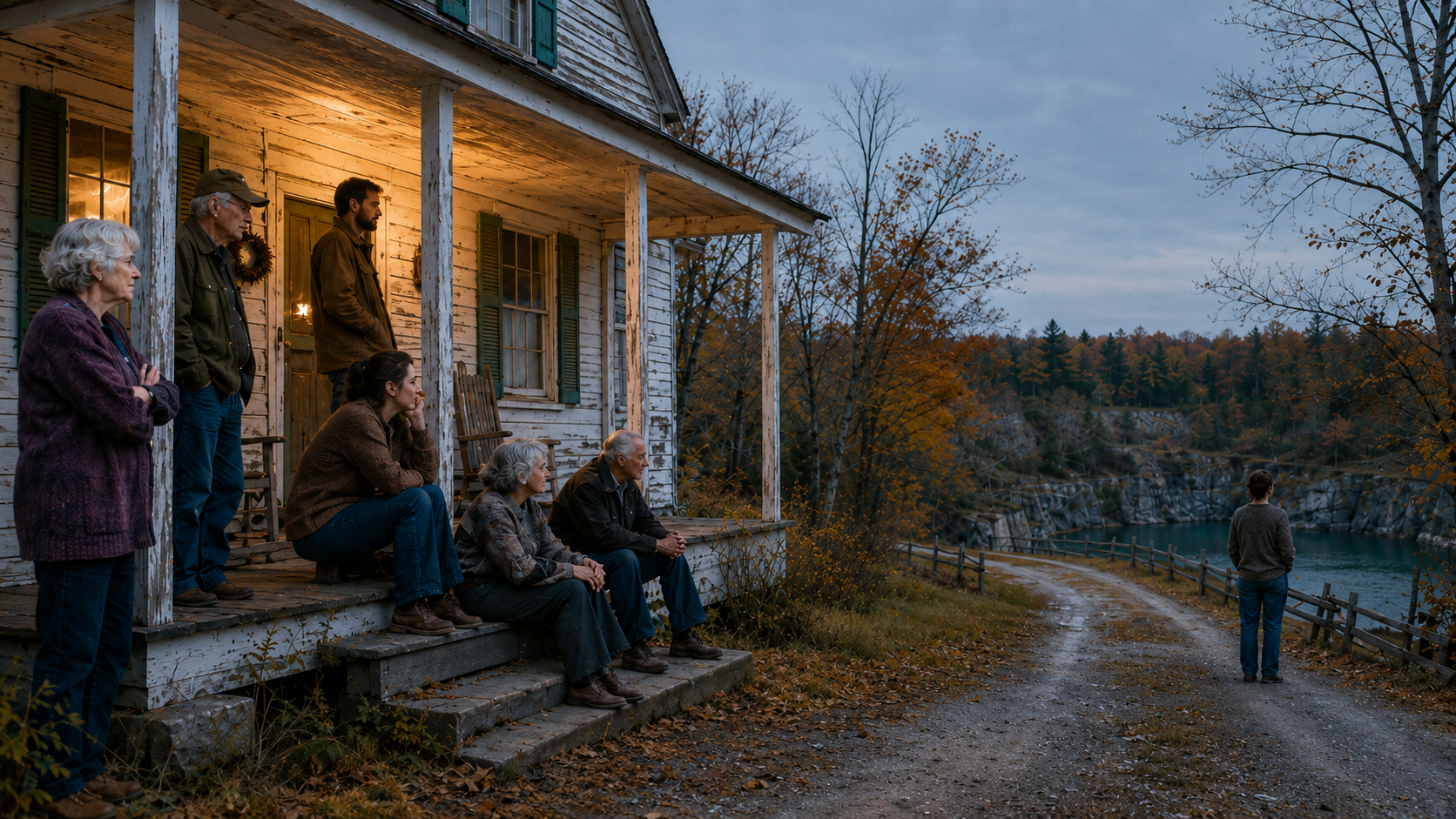
Lila brought her grandmother down from Cedar Run on Sunday morning, with the doctor’s grudging blessing and the aide’s careful packing of a small bag of medicines, and she carried her up the porch steps of 412 Quarry Road in her arms because the wheelchair would not take the steps and because Stefania, in spite of everything, weighed about as much as a small bag of laundry now. Stefania put her face against Lila’s shoulder on the way up and said, into the wool of her coat, “You are a good girl, Lila. You always were a good girl.” It was the first time her grandmother had said it to her in English, in those words, in her whole life.
Joseph was already there. He had walked down. He was ninety-seven years old and he had walked the half mile down the gravel from his own house in his good coat, with a wax-paper-wrapped loaf of his daughter-in-law’s poppyseed bread under one arm and a small jar of his own honey under the other. Rose had been in the kitchen since seven. She had cleaned the stove, which had not been cleaned for the sale yet because Lila had not gotten to it. She had put on a pot of bigos, the hunters’ stew, the Polish thing her mother had taught her as a girl that her mother had not eaten in twenty years and that her mother would smell, now, the moment Lila brought her through the kitchen door. The radio on the counter was on the polka station, low. The light came in the window over the sink the way Lila remembered the light coming in that window every Sunday morning of her childhood.
They sat Stefania at the head of the kitchen table, in the chair that had been her grandfather’s. Joseph took the chair opposite her, which had been her grandmother’s. Rose sat to Stefania’s right. Lila sat to Stefania’s left. The kitchen was warm. The bigos was hot. Joseph said grace in Polish, which he had not been asked to do in this house for seventy-eight years, and the three women answered Amen.
For a long while they did not talk much. They ate. Stefania ate slowly the way she ate now, but she ate. The polka radio played the kind of song that had been recorded in Pittsburgh in 1962 and pressed by a small label that did not exist anymore and that the station kept playing because the old people kept calling in to ask for it. Joseph hummed along under his breath at one point, without thinking, the way an old man does, and when he caught himself he flushed and stopped, and Stefania reached across the table and put her hand on his hand and said, in their language, “Don’t stop, Józef. You hum. You have always known the tune better than I did.”
He left his hand under hers a long moment. Then he turned it over and held hers.
They stayed that way through the second helping of bigos, with Lila and Rose looking at their plates because the small wonder of it was a thing best given the privacy of two daughters’ downcast eyes. Rose was a sixty-eight-year-old woman in her own mother’s kitchen on a Sunday morning watching the man who had loved her mother since they were both teenagers, and her mother, finally, in the last open hour of either of their lives, hold his hand across the oilcloth at the kitchen table. There were a lot of things you could say about that and there was nothing you needed to say about that.
Father Karol came after lunch. He brought a manila folder, which was a thing he could not seem to be without that week. In it he had Tadeusz’s letter, professionally photographed and cleanly translated for the family record, and the baptismal card from the camp, scanned in the parish office, and the original photographs, returned to the family. He also had, paper-clipped to the inside, a typed note from the diocesan office formalizing the parish gift of a single plot in consecrated ground in perpetuity for Mikołaj Sikora and noting, in a separate paragraph, that the parish would accept the Quarry Road parcel as a donation if the family wished to make one, and would keep it as parish land, undeveloped, in memory.
Rose looked at Lila. Lila looked at her grandmother.
“Babcia. The parcel up the road. If we give it to St. Hedwig’s, they won’t sell it. It will sit. It will be a quiet piece of ground. Forever.”
Stefania looked at the document in Father Karol’s hand. She looked at Joseph. Joseph nodded once, the smallest nod, the nod of a man who had walked that strip beside her for seventy-eight years and had thought about its fate every winter.
“Yes, Karolu,” her grandmother said. “Give it to the parish. Let it be quiet for good.”
“I will draw up the papers Monday, Pani.”
“Thank you, Karolu. For all of it.”
He stayed for a piece of the poppyseed bread, which was as good as Joseph’s daughter-in-law had claimed it would be, and then he went home. Stefania, by then, was tired. They moved her into the front room and put her in the recliner, which they had brought back into the room from the storage that morning for the purpose, and she fell asleep with the November light on her face and Joseph in the chair beside her with his cap on his knee.
Rose stood with Lila at the kitchen sink doing the dishes.
“Lila.”
“Yes, Mom.”
“I would like, if it is all right with you, to keep this house through Christmas. We can list it in January. We can list it whenever we want. But your father is buried in the Tannenbaum plot in Easton, and I have not had a Christmas in this kitchen since he was alive, and your grandmother is going to want a Christmas in this kitchen, and Joseph is going to want a Christmas at this kitchen, and I am going to want my mother to have one more Christmas at this kitchen before whatever is coming for any of us comes for any of us.” Her mother did not look at her. She kept washing. “I have not asked you for anything, in your adult life, that I can remember. I would like to ask for that.”
“Yes, Mom. We’ll keep it through Christmas.”
“Thank you.”
“Mom.”
“Yes.”
“I would like to stay through Christmas too. If that’s all right.”
Her mother set down the plate she was washing. She did not turn. Her shoulders, after a moment, went down a quarter inch from where Lila had not until this minute realized she had been holding them.
“It is all right with me, Lila. It would be more than all right with me.”
The polka radio went on quietly. The sun moved across the linoleum. In the front room, the man at ninety-seven and the woman at ninety-six, who had stood next to each other in a hole in the ground at nineteen and eighteen and had not been allowed by life to stand next to each other since, sat in the same warm room with the November sun on them.
Late in the afternoon, Lila took her car up the road by herself. She drove past the bend slowly. The work lights were gone. Mr. Knapp had filled the hole and raked the strip back to its quiet, the way Joseph had filled it in ‘forty-eight. The parish would put up a small wooden sign before long, the kind of sign that said quietly that this was a piece of ground belonging to St. Hedwig of Silesia Parish, please do not disturb, but the sign was not up yet, and for now the strip looked exactly like what it had been when she first drove past it three weeks ago, which was a piece of unworked ground at a bend in a road in a Pennsylvania cement town that nobody would ever notice for any reason.
A road. A bend in a road. A piece of ground.
She sat in the car a long moment with the engine off. The November light went thin and gold in the trees. Down at the end of the road, her grandmother’s house, the house with the white clapboard and the green shutters and the porch that sagged on the east side, had its lights on against the dusk. Her mother was at the kitchen window. Joseph was at the front-room window with her grandmother, who was presumably still asleep in the recliner, the light on her face.
In the back seat of the car, in a brown envelope, was the FOR SALE sign she had picked up from the realtor’s office on Tuesday morning, the morning of the polkas and the photograph, the morning before any of this. She had not put it in the yard yet. She did not put it in the yard now. She would not put it in the yard in January either, when Rose called the realtor, because in January she would call her mother first and say what she had been thinking about saying since the moment the bigos had come out of the pot at noon, which was that she did not want to sell the house, that she could work from anywhere, and that she would like, in her thirty-eighth year, to be the next woman in her line to live at the end of Quarry Road. She did not know yet whether her mother would say yes to that. She knew her mother might. She knew it was a thing that could be said now, between them, in a way it could not have been said a month ago, because they were different women now to each other than they had been a month ago, and the road outside the window was a different road, and the strip up at the bend was a different strip, and the long quiet that had been between them since Lila was old enough to know there was a quiet was not the same kind of quiet anymore.
She started the car. She drove down the road. She parked in the gravel by the kitchen door. She got out. The polka station was still going faintly through the window. Joseph was laughing at something her mother had said. Her grandmother was awake again, by the sound of her voice from the front room, calling for Joseph to come and look at something out the window with her.
Lila came up the porch steps. She stopped at the door. She looked one last time, up the road, into the November dusk, at the bend in the road where the haul road turned toward the water and where for seventy-eight years the women of her family had each carried in her pocket a piece of ground that none of the others could be told about.
The bend was just a bend in a road.
She opened the kitchen door and went inside, where her family was waiting, and she closed the door behind her.
-THE END-
The Reading Room — All Chapters
- Chapter 1/Episode 1: The Last House on Quarry RoadAfter Years Away, A Daughter Comes Home To Empty A House
- Chapter 1/Episode 2: The Piece That Does Not Get SoldA grandmother's strange rule about one strip of land.
- Chapter 1/Episode 3: The Man Half a Mile Up the RoadThe Neighbor Who Knew Her Grandmother Before The Family Did
- Chapter 1/Episode 4: Throw It Out, Don't LookWhy Does Her Mother Want These Boxes Thrown Out Unopened?
- Chapter 1/Episode 5: The Wardrobe With a Hollow BackShe Knocked On The Wardrobe And It Answered Wrong
- Chapter 1/Episode 6: Moving DayThe Day They Carried The Last Of Her Life Out The Door
- Chapter 1/Episode 7: What Was Behind the Cedar PanelAlone In The Empty House, She Finally Lifts The Panel
- Chapter 1/Episode 8: The Gown and the PhotographInside The Tin, A Tiny Gown And A Face She Knows
- Chapter 1/Episode 9: A Name Nobody Will SayShe Brings The Photograph To Her Mother And Gets A Door Slammed
- Chapter 1/Episode 10: The Child She Buried by the RoadAt Last, Her Grandmother Speaks The Name She Hid For A Lifetime
- Chapter 2/Episode 1: The Camp Stefania Never Spoke OfAfter A Lifetime Of Silence, A Place Has A Name
- Chapter 2/Episode 2: The Picture Lands on the TableHer Mother Has To See The Photograph Sooner Or Later
- Chapter 2/Episode 3: The Margin of the Old BookIn The Parish Archive, A Note Nobody Has Read In Decades
- Chapter 2/Episode 4: The Cold Little House at the End of the RoadNovember 1948: A Girl, A Baby, A Stranger's Front Door
- Chapter 2/Episode 5: The Boy with the FirewoodA Stranger Brings Wood To The Door And Will Not Look Away
- Chapter 2/Episode 6: The Note Father Stachura ReadThe Old Priest's Note Sends Lila Looking Somewhere Else
- Chapter 2/Episode 7: That Long Night Before ChristmasDecember 1948: A Fever That Will Not Break
- Chapter 2/Episode 8: The Iron Ground at the Bend in the RoadHe Came In The Morning And Did Not Ask A Single Question
- Chapter 2/Episode 9: What Father Bryla Did Not Write DownShe Came To Confess And He Carried It Seventy-Eight Years
- Chapter 2/Episode 10: The Photograph He Had Kept All Those YearsA Priest, A Grandmother, A Granddaughter, In One Small Room
- Chapter 3/Episode 1: That Figure He Saw on the RoadThere Was Another Night, Another Death, On This Same Road
- Chapter 3/Episode 2: The Summer Rose Was FifteenHer Mother Stops Pretending The Quarry Was Just A Place
- Chapter 3/Episode 3: The Day They Agreed to DigFive People In One Room Choose A Morning To Open The Ground
- Chapter 3/Episode 4: The Box at the Bend in the RoadAt Dawn, A Wooden Box Comes Up Out Of Iron Ground
- Chapter 3/Episode 5: She Carried That Letter in Her Heart Since ’48At The Graveside, Her Grandmother Reads One More Page
- Chapter 4/Episode 1: Bells Chime His NameA Funeral Mass, A Small New Stone, His Name Spoken at Last
- Chapter 4/Episode 2: It's Only A RoadThe Morning After, A Family Sits Down To One Warm Meal
Please, the author’s name. I truly enjoyed this and want to read more of the stories.
Thank you
I hope you will start another story.
Yes!! I want more stories too!
A wonderful and touching story. I hope you will offer more.
Thank you,
Lynn Allen Weaver