
She Came To Confess And He Carried It Seventy-Eight Years
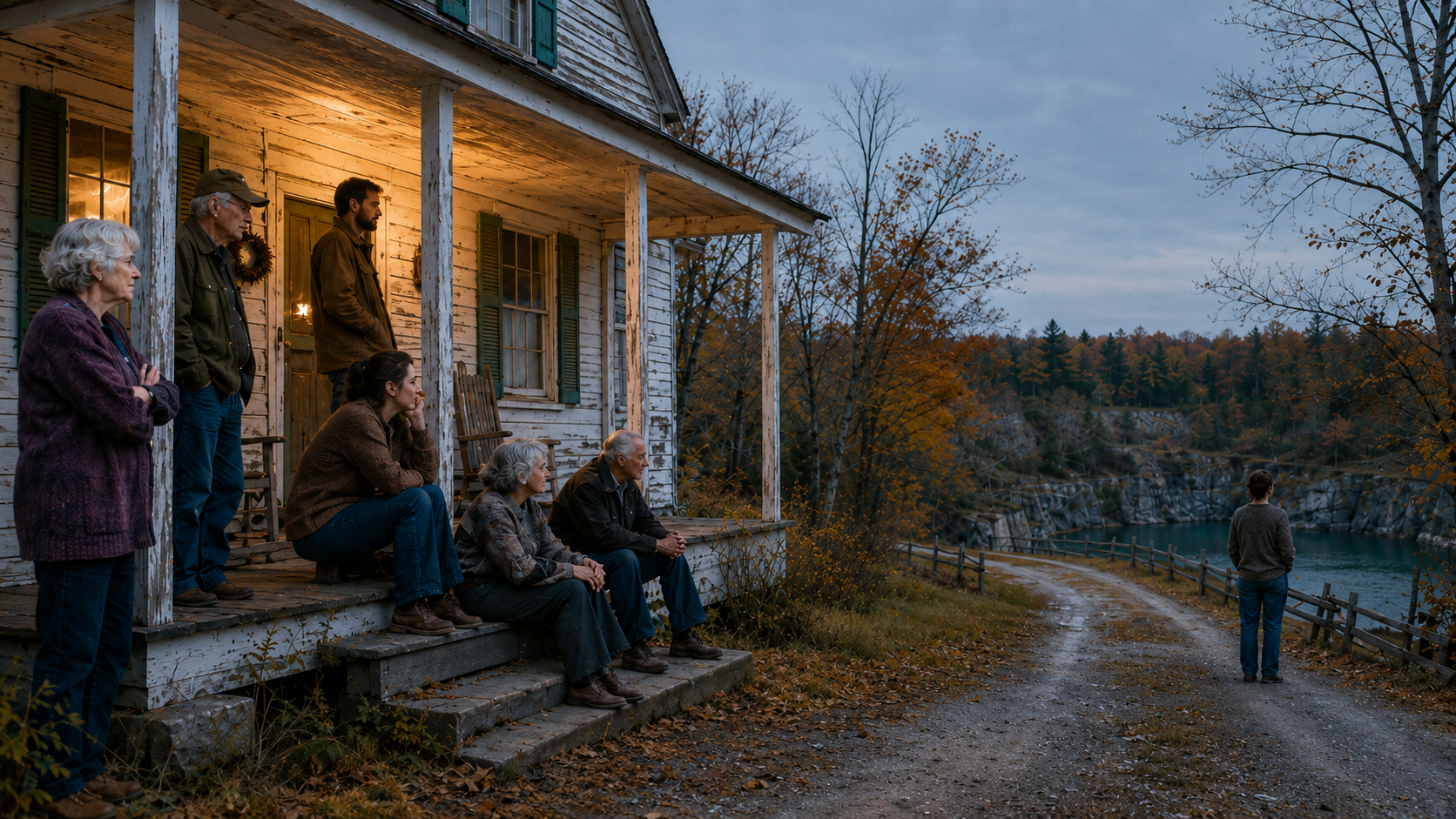
The night is what it is. They wait until the stars are out. Joseph comes up the lane at dusk in his father’s old farm truck, with the wooden box and the pick and the spade in the bed under a tarp and a coil of clean rope and a kerosene lantern with the wick trimmed low, and he brings, also, a small round of bread and a thermos of soup that his mother has put up, because his mother does not know what for and has asked no questions either. The Mazur women, Stefania will understand later in her life, are a long line of women who have not asked.
They go up the road to the bend where the haul road turns toward the flooded workings. There is a strip of unworked ground at the bend, a piece nobody plants and nobody quarries because of the way the limestone shelves underneath it, a strip the parish has owned and has done nothing with for decades. Joseph has thought it through, in the few hours he has had, the way an honest farm boy thinks a thing through when he has been handed something that needs handling correctly. The strip is set back from the road. It is screened by the trees. It is on parish ground. And it is not consecrated.
The ground is like iron. He has told her this, on the porch before they got into the truck, that the ground in December in Pennsylvania is like iron, and he has said it more than once because he has wanted her to be prepared for the sound of the pick. The sound of the pick is the loudest sound she will hear for many years. He swings it. She holds the lantern. He swings it again. She holds the lantern. They take turns, because she has insisted, and because he does not argue with what she is insisting on tonight. They dig until the morning star is up over the eastern ridge and they have made a small place in the ground that is the right size and not one inch larger.
They put Mikołaj in the box. They put the small things with him, the gown that Marta began and Stefania finished, the photograph from the camp that the American with the camera had given them the autumn before, the letter Tadeusz had written her in the infirmary that she has not read in months, the small camp baptismal card that Father Józef the camp chaplain had pressed into her hand when Marta died. Joseph does not look at these things. He looks at the lantern. He has decided that whatever she is putting in the box is none of his business, and he does not look. The lid goes on. The box goes down.
Joseph fills the hole.
When it is done she kneels by the worked place and she says the small Polish prayer that the women in the camp had said over the dead when there were too many to say a longer one, and Joseph stands a few feet off with his cap in his hand. The morning star is paling. The roosters have started up the valley. He helps her to her feet because by now her knees will not work. They walk down the road to the truck. He does not put his arm around her. He does not touch her the whole way down, and she understands, even in the state she is in, that he will not touch her any further than he has touched her, and she carries that knowledge home with her, and they put the tools back in the bed, and he drives her down to St. Hedwig’s in the gray first light.
The rectory door has a brass bell pull, dulled with handling. She lifts it. She does not pull. Joseph waits in the truck at the curb.
After a moment she pulls the bell.
Father Bryla opens the door himself. He is in his black cassock with the collar still unbuttoned at the throat, the way a young priest looks who has been up since four for his office, and he sees her on his doorstep at half past six in the morning with her face and her shoes, and he steps back at once.
“Pani Stefaniu. Come in. Come in.”
He takes her to the small sacristy where the morning light comes in over the vestments. He does not light a lamp. He does not call for the housekeeper. He sits her down on the bench against the wall and he kneels beside her, in his cassock, on the cold tile, so that he is below her eye and she does not have to look up at him.
“I am ready, Father,” she says, in Polish. “I would like to be heard.”
“I am here, child.”
She tells him. She tells him all of it, in Polish, in the small clean room, in the gray light, and her voice does not break, and she leaves nothing out. She tells him about Marta and about Marta’s words about taking the boy. She tells him about Tadeusz and the letter and the infirmary. She tells him about the camp baptism. She tells him about why she did not call Mr. Barnes the doctor. She tells him about the strip at the bend in the road, and about the box, and about Joseph waiting at the curb in his father’s truck. She tells him about the gown and the photograph and the letter and the small card, all in the box now under iron ground.
He listens. He does not interrupt her. He is a young priest, twenty-six years old, in his first parish, and he has heard, in his short time as a confessor, the small adulteries of cement workers and the small angers of housewives, and he has not heard, before this morning, anything resembling this. He listens with his hands folded on his knee and his head a little bowed, and when she has finished he is silent for a long moment, and then he speaks, in their language, very quietly.
“Pani Stefaniu,” he says, “you have not done a thing I cannot absolve. You have done what a sister does for a sister, and what a mother does for a child entrusted to her, and what a poor frightened girl does in a country she does not know, and the loving of him was the holiest of those things, and the burying of him was the bravest of them, and the not calling the doctor was the most human of them. There is, in what you have told me, no sin so heavy I cannot lift it from you. I lift it from you. Do you understand, child.”
“Yes, Father.”
“I am bound by the seal of what you have told me. I will carry it as long as I live and not a word of it to anyone, not to the pastor, not to the bishop, not even to a successor, not even on my own deathbed unless you give me leave then. Do you understand.”
“Yes, Father.”
“What you have buried up the road, I cannot move. It is not in consecrated ground and I have no priestly power to make ground consecrated that has not been blessed. But I can pray over it, with you, where it lies. And one day, when the ground may be opened and the matter brought into the light, the child will have his proper rest. We do not know when. We know only that there is a road to it, and that we will walk that road if we are given the years for it.” He looked up at her. “We will walk it together, you and I, as long as we are both alive in this country.”
“Yes, Father.”
He absolves her in the form of the sacrament and she lets the words come down on her like the first hot water of a bath after a long cold day, and afterward he asks her, gently, if she will take a cup of tea in the kitchen before she goes back to the widow’s house with Joseph Mazur, and she says she will, and they sit together in his small rectory kitchen as the day comes up over Sandstone Falls and the bells of St. Hedwig’s begin to ring for the first Mass.
That is the morning. She will remember it whole, the rest of her life. She will be ninety-six years old in a dayroom in 2026 and remember the gray light on the cold tile and the kindness of his face.
In the present, Lila’s phone rings on a Wednesday afternoon while she is sitting at her kitchen table with the recording playing.
“Mrs. Lila.” Father Karol’s voice on the other end is steady, but it is the kind of steady that has been working at being steady. “Mrs. Lila, you should come. He is awake. He is fully here. He has asked for your grandmother. He has asked for you. The nurse says I am to tell you he has perhaps two hours before he sleeps again, and she does not know how he will be tomorrow. I am going up to Cedar Run now to bring your grandmother in the wheelchair van. I will meet you at the rectory.”
She does not let herself think about the implication of the verb the nurse has chosen. She picks up her keys.
The Reading Room — All Chapters
- Chapter 1/Episode 1: The Last House on Quarry RoadAfter Years Away, A Daughter Comes Home To Empty A House
- Chapter 1/Episode 2: The Piece That Does Not Get SoldA grandmother's strange rule about one strip of land.
- Chapter 1/Episode 3: The Man Half a Mile Up the RoadThe Neighbor Who Knew Her Grandmother Before The Family Did
- Chapter 1/Episode 4: Throw It Out, Don't LookWhy Does Her Mother Want These Boxes Thrown Out Unopened?
- Chapter 1/Episode 5: The Wardrobe With a Hollow BackShe Knocked On The Wardrobe And It Answered Wrong
- Chapter 1/Episode 6: Moving DayThe Day They Carried The Last Of Her Life Out The Door
- Chapter 1/Episode 7: What Was Behind the Cedar PanelAlone In The Empty House, She Finally Lifts The Panel
- Chapter 1/Episode 8: The Gown and the PhotographInside The Tin, A Tiny Gown And A Face She Knows
- Chapter 1/Episode 9: A Name Nobody Will SayShe Brings The Photograph To Her Mother And Gets A Door Slammed
- Chapter 1/Episode 10: The Child She Buried by the RoadAt Last, Her Grandmother Speaks The Name She Hid For A Lifetime
- Chapter 2/Episode 1: The Camp Stefania Never Spoke OfAfter A Lifetime Of Silence, A Place Has A Name
- Chapter 2/Episode 2: The Picture Lands on the TableHer Mother Has To See The Photograph Sooner Or Later
- Chapter 2/Episode 3: The Margin of the Old BookIn The Parish Archive, A Note Nobody Has Read In Decades
- Chapter 2/Episode 4: The Cold Little House at the End of the RoadNovember 1948: A Girl, A Baby, A Stranger's Front Door
- Chapter 2/Episode 5: The Boy with the FirewoodA Stranger Brings Wood To The Door And Will Not Look Away
- Chapter 2/Episode 6: The Note Father Stachura ReadThe Old Priest's Note Sends Lila Looking Somewhere Else
- Chapter 2/Episode 7: That Long Night Before ChristmasDecember 1948: A Fever That Will Not Break
- Chapter 2/Episode 8: The Iron Ground at the Bend in the RoadHe Came In The Morning And Did Not Ask A Single Question
- Chapter 2/Episode 9: What Father Bryla Did Not Write DownShe Came To Confess And He Carried It Seventy-Eight Years
- Chapter 2/Episode 10: The Photograph He Had Kept All Those YearsA Priest, A Grandmother, A Granddaughter, In One Small Room
- Chapter 3/Episode 1: That Figure He Saw on the RoadThere Was Another Night, Another Death, On This Same Road
- Chapter 3/Episode 2: The Summer Rose Was FifteenHer Mother Stops Pretending The Quarry Was Just A Place
- Chapter 3/Episode 3: The Day They Agreed to DigFive People In One Room Choose A Morning To Open The Ground
- Chapter 3/Episode 4: The Box at the Bend in the RoadAt Dawn, A Wooden Box Comes Up Out Of Iron Ground
- Chapter 3/Episode 5: She Carried That Letter in Her Heart Since ’48At The Graveside, Her Grandmother Reads One More Page
- Chapter 4/Episode 1: Bells Chime His NameA Funeral Mass, A Small New Stone, His Name Spoken at Last
- Chapter 4/Episode 2: It's Only A RoadThe Morning After, A Family Sits Down To One Warm Meal