
Her Mother Stops Pretending The Quarry Was Just A Place
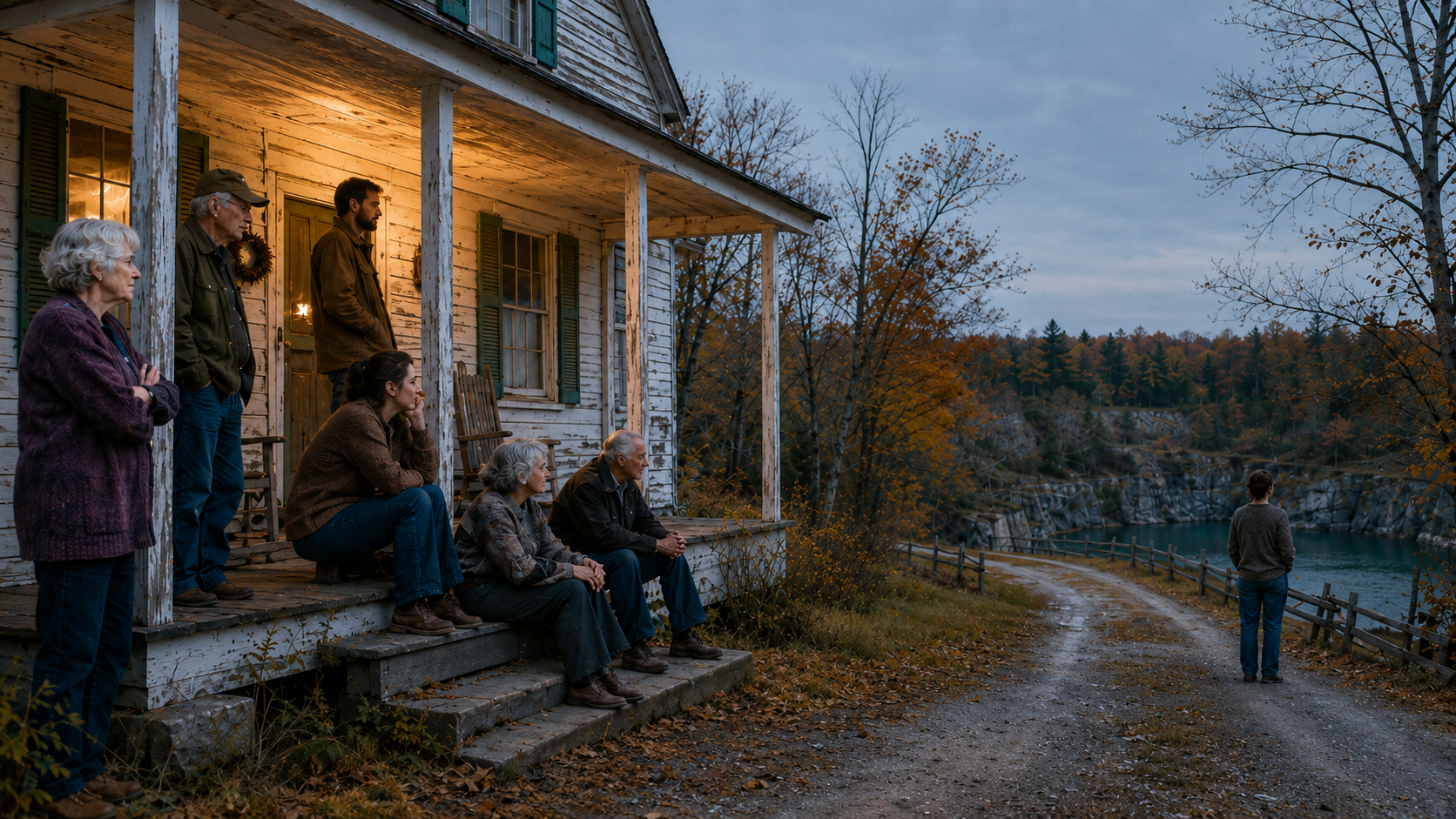
Lila came in the next morning without knocking, because at this point what was between her and her mother had moved past knocking. Rose was at the kitchen table in her good blouse with her hair already set, as if she had been expecting somebody to come, only she had not known yet which somebody it would be.
“Joseph Mazur came to my kitchen last night,” Lila said. She sat down across from her mother. She did not lay the recorder out. She did not need to. “He told me what he saw the morning Peter died.”
Her mother’s hand went still on the table.
“Mom.”
“What did he see, Lila.” Her mother said it very evenly. The brittle voice was not there. The flat door-closing voice was not there. It was the same voice as the morning at the photograph, the woman who had run out of room to pretend.
“He saw a small figure run down the road from the bend by the quarry at first light. A small figure in light clothes. He could not tell who it was. He saw it stop, catch its breath, and run on, into Babcia’s lane, until the porch light came on at the house. Twenty minutes later the state police came to his door about Peter.”
Her mother looked at her hand on the table.
“He never asked you,” Lila said. “He never asked Babcia. He never asked anybody. For fifty-three years. He said it was because of what he owed Babcia from another night a long time before. He said yesterday that he thought the two of you ought not to die without learning that you have been carrying something on the same stretch of road.”
Rose closed her eyes.
There was a long moment in which the kitchen was nothing but the tick of the wall clock that Lila’s father had bought at a flea market in 1989 and that her mother had wound every Sunday since. Rose’s chest rose and fell, once, twice. She opened her eyes. She looked at her daughter for a long, almost shy moment, and Lila understood that her mother was about to tell her something she had never told anyone, including the husband she had buried eleven years ago, and that it was costing her, even now, even after everything, the way the very first telling of a thing always cost more than any of the later tellings would.
“His name was Peter,” Rose said. “Peter Joseph Mazur. I called him Pete. He hated being called Pete by anybody else. He had brown eyes that did not match the rest of his face, you know how some boys are made out of two different boys, that was him. He was an artist. He had a sketchbook in his back pocket from the time he was twelve and he drew everything, our road, the cement plant from across the field, his mother in her chair, me when I wasn’t looking. I have one of his drawings in my dresser. I have looked at it every Sunday before church since 1973, and I have never told a soul I have it. It is of the porch of this house. I am not in it. He drew the porch one evening when he was waiting for me to come out.”
She paused. She put her hand flat on the oilcloth.
“We had been together since the April before. We kept it to ourselves because, Lila, the Wojciks and the Mazurs did not really know each other. We were neighbors, we said hello at Mass, my mother would send me up the road with a pie at Christmas, his mother would send him down with a basket of apples in the fall. But it was always a stiff thing, between the houses. I never understood why, then. I thought it was just how people were. I understood last week. After your photograph.”
“I’m sorry, Mom.”
“Don’t be sorry for that. I’m telling you what I understand now.” Her mother took a breath. “The night of the sixteenth of July, ‘seventy-three. We had been at the pool earlier. We had been there with other kids, the Kowalik twins, the Polidoro girl, Robby Marsh. The other kids left around ten. I was supposed to be at the Polidoro girl’s, that was my cover. Pete was supposed to be at Robby’s. We stayed. We had the place. The moon was up. The water was warm.”
She stopped. She did not look at Lila.
“He climbed up to the ledge, Lila. He had done it a hundred times. He went off it, just to show off, the way boys do, the dive that he could do better than any of the other boys. And the water took him. I do not know what it was. The current, the cold layer, a strike against the rocks underneath the ledge that none of us could see. He did not come up. I waited. I waited so long, Lila. I waited until my hands were not my hands anymore. I went in. I could not find him. I went out. I went in again. I went out. I sat on the rocks and I shouted his name into the water until my throat would not give me any more sound. And then I knew. I just knew. The way a fifteen-year-old girl knows when there is no point trying anymore.”
She did look at Lila now. There were no tears in her eyes. There had not been tears in her mother’s eyes in this conversation. Lila understood that her mother had used up the tears for this story in the year of 1973 and had been a person without spare tears for this story ever since.
“I ran. I ran down the road. I did not think about it. I ran. Joseph Mazur saw me from his window and he could not have known it was me, I was a little thing in the dark, but it was me. I came down here and I went in the back door and I went up the stairs and I woke my parents in their bed, and I said, I said, Peter Mazur went swimming at the quarry and he did not come back, and somebody needs to call the state police. And that was the lie I told. The lie was that I had gone home earlier. The lie was that he had stayed to swim alone. The lie was that I had been worried when he did not come home and had run over from my friend’s house to wake my parents.” Her mother shook her head. “I have lived inside that lie my whole adult life. It became the truth. It became what I believed when I tried to remember it. But the actual truth is, I was on the rocks. I had been on the rocks for an hour by then. I watched my Peter dive in and not come up, and I let the town call him a boy who went swimming alone.”
“Mom.”
“I buried his ring up at the bend, Lila. The night after the funeral. I took his sketchbook that his mother had given me at the wake because she said I had been a good friend to her son, she did not know I had been more, and I took two of his letters that he had folded into little squares and slipped to me at Mass, and I took the ring he had given me at Easter that I had never been able to put on at home, and I went up the road in the dark with a trowel from my father’s shed, and I buried them at the bend, because that was where the unworked strip was, and I had walked up there with my mother enough Sundays after Mass to know that that was the piece of ground in this whole town where you could put a thing and nobody would ever turn a spade in it again.”
The clock ticked. Lila could not breathe quite right.
“You don’t know this, Lila, but my mother went up to that strip every day of my childhood. Some days only for ten minutes. Some days for an hour. She had a path she walked. I asked her once when I was eight what was up there. She said, nothing, dziecko. She said, just my piece of quiet. And I, when I needed a piece of quiet of my own at fifteen years old, I went and put my piece of quiet in the same ground.” She lifted her eyes. “I buried Peter’s things on the very strip my mother had buried her Mikołaj on, twenty-five years before, and neither of us ever knew it about the other. Lila, do you understand what I am telling you. We have been mother and daughter for sixty-eight years and we have been carrying the same stretch of ground in our pockets and neither of us has ever said a word to the other about it.”
The Reading Room — All Chapters
- Chapter 1/Episode 1: The Last House on Quarry RoadAfter Years Away, A Daughter Comes Home To Empty A House
- Chapter 1/Episode 2: The Piece That Does Not Get SoldA grandmother's strange rule about one strip of land.
- Chapter 1/Episode 3: The Man Half a Mile Up the RoadThe Neighbor Who Knew Her Grandmother Before The Family Did
- Chapter 1/Episode 4: Throw It Out, Don't LookWhy Does Her Mother Want These Boxes Thrown Out Unopened?
- Chapter 1/Episode 5: The Wardrobe With a Hollow BackShe Knocked On The Wardrobe And It Answered Wrong
- Chapter 1/Episode 6: Moving DayThe Day They Carried The Last Of Her Life Out The Door
- Chapter 1/Episode 7: What Was Behind the Cedar PanelAlone In The Empty House, She Finally Lifts The Panel
- Chapter 1/Episode 8: The Gown and the PhotographInside The Tin, A Tiny Gown And A Face She Knows
- Chapter 1/Episode 9: A Name Nobody Will SayShe Brings The Photograph To Her Mother And Gets A Door Slammed
- Chapter 1/Episode 10: The Child She Buried by the RoadAt Last, Her Grandmother Speaks The Name She Hid For A Lifetime
- Chapter 2/Episode 1: The Camp Stefania Never Spoke OfAfter A Lifetime Of Silence, A Place Has A Name
- Chapter 2/Episode 2: The Picture Lands on the TableHer Mother Has To See The Photograph Sooner Or Later
- Chapter 2/Episode 3: The Margin of the Old BookIn The Parish Archive, A Note Nobody Has Read In Decades
- Chapter 2/Episode 4: The Cold Little House at the End of the RoadNovember 1948: A Girl, A Baby, A Stranger's Front Door
- Chapter 2/Episode 5: The Boy with the FirewoodA Stranger Brings Wood To The Door And Will Not Look Away
- Chapter 2/Episode 6: The Note Father Stachura ReadThe Old Priest's Note Sends Lila Looking Somewhere Else
- Chapter 2/Episode 7: That Long Night Before ChristmasDecember 1948: A Fever That Will Not Break
- Chapter 2/Episode 8: The Iron Ground at the Bend in the RoadHe Came In The Morning And Did Not Ask A Single Question
- Chapter 2/Episode 9: What Father Bryla Did Not Write DownShe Came To Confess And He Carried It Seventy-Eight Years
- Chapter 2/Episode 10: The Photograph He Had Kept All Those YearsA Priest, A Grandmother, A Granddaughter, In One Small Room
- Chapter 3/Episode 1: That Figure He Saw on the RoadThere Was Another Night, Another Death, On This Same Road
- Chapter 3/Episode 2: The Summer Rose Was FifteenHer Mother Stops Pretending The Quarry Was Just A Place
- Chapter 3/Episode 3: The Day They Agreed to DigFive People In One Room Choose A Morning To Open The Ground
- Chapter 3/Episode 4: The Box at the Bend in the RoadAt Dawn, A Wooden Box Comes Up Out Of Iron Ground
- Chapter 3/Episode 5: She Carried That Letter in Her Heart Since ’48At The Graveside, Her Grandmother Reads One More Page
- Chapter 4/Episode 1: Bells Chime His NameA Funeral Mass, A Small New Stone, His Name Spoken at Last
- Chapter 4/Episode 2: It's Only A RoadThe Morning After, A Family Sits Down To One Warm Meal